
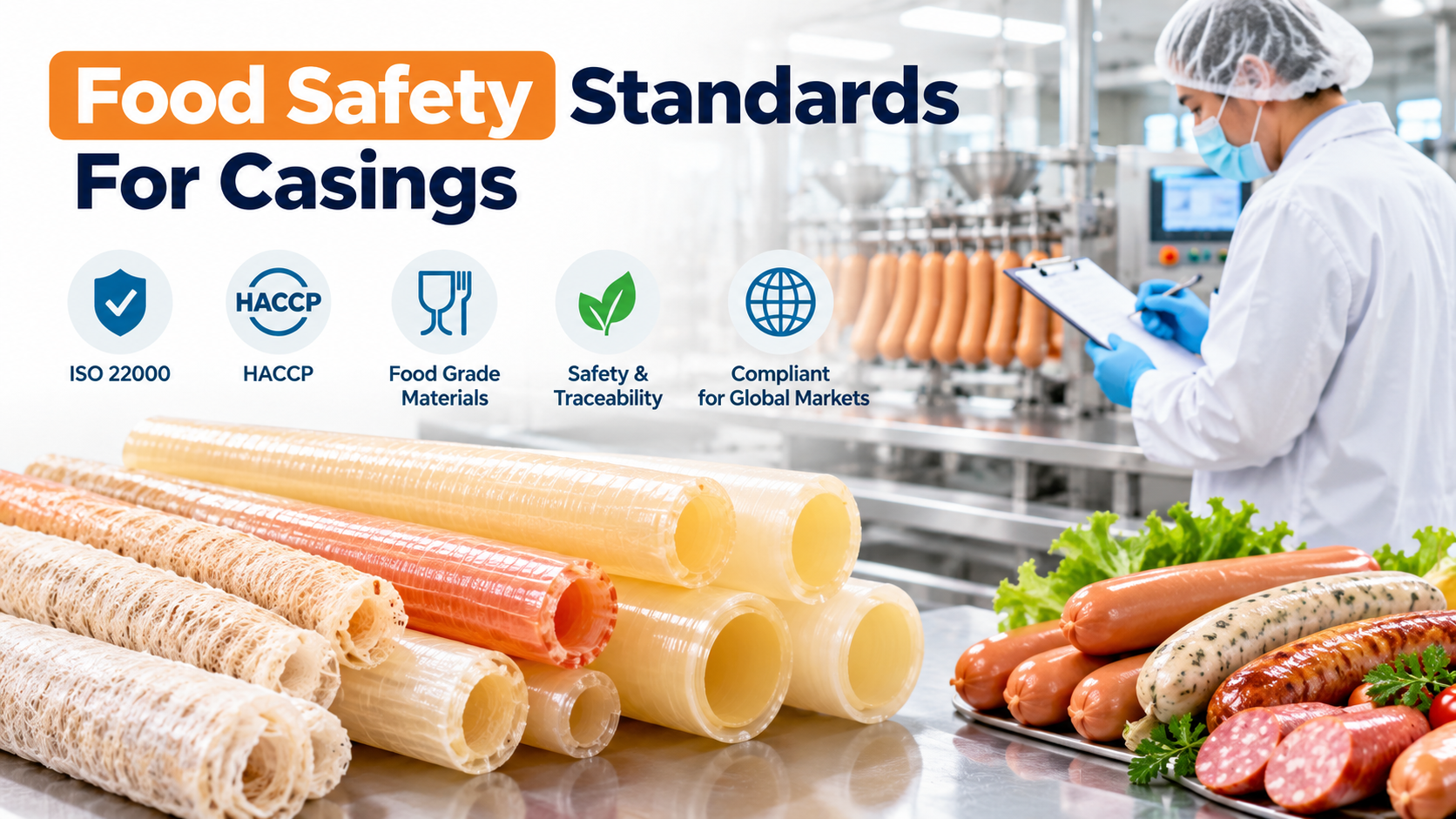
Food safety standards for sausage casings are heavily regulated globally because casings come into direct contact with raw meat and often remain part of the final product. Regulations target three primary categories of risk: biological contamination (pathogens), chemical safety (residues, migration), and traceability.
1. Natural Casings: Biological & Veterinary Controls
Because natural casings are animal by-products, food safety focuses heavily on veterinary inspection, processing hygiene, and the elimination of zoonotic risks.
Veterinary Certification & Animal Health
- Country of Origin Clearance: Import/export standards require strict certification that the source animals originate from regions free of high-risk diseases like Foot-and-Mouth Disease (FMD), African Swine Fever (ASF), and Bovine Spongiform Encephalopathy (BSE).
- BSE Mitigation: For bovine (beef) casings, international standards require the complete removal of Specified Risk Materials (SRMs). In many jurisdictions, the ileum (the lower part of the small intestine) is strictly banned from food chains due to BSE risks.
Microbiological Critical Control Points (CCPs)
Processing plants utilize Hazard Analysis Critical Control Point (HACCP) systems to manage biological risks.
- Pathogen Limits: Final products must test negative for major foodborne pathogens, specifically Salmonella spp., Listeria monocytogenes, and Escherichia coli.
- Water Activity (
) and Salting: Proper curing is a primary food safety hurdle. Casings must be saturated with dry salt or brine to drop the water activity below 0.85, a threshold that halts the growth of pathogenic bacteria.
2. Artificial Casings (Collagen & Plastic): Material Safety
For manufactured casings, food safety standards shift from veterinary hygiene to chemical migration limits and food-contact material compliance.
Collagen Casings Standards
- Sourcing Restrictions: The collagen must be extracted exclusively from hides of animals that have been declared fit for human consumption by official veterinary authorities.
- Chemical Residue Limits: Limits are strictly enforced for processing aids. For example, rules limit residual glutaraldehyde or formaldehyde (sometimes used for cross-linking to add strength) and heavily regulate heavy metals (lead, arsenic, chromium) used during hide preparation.
Plastic Casings Standards
Plastic casings must comply with global regulations for Food Contact Materials (FCM), such as FDA Title 21 CFR in the US and Regulation (EU) No 10/2011 in Europe.
- Overall and Specific Migration Limits (SML): Tests ensure that chemical components of the plastic (like monomers or plastic additives) do not migrate into the sausage meat above safe thresholds.
- Banned Substances: Modern food safety standards strictly prohibit the use of certain phthalates and Bisphenol A (BPA) in plastic casings due to endocrine-disruption risks.
3. Global Frameworks and Audits
Sausage casing manufacturers operating internationally must align with highly standardized global audit benchmarks to supply commercial food processors:
| Standard / Framework | Focus Area | Impact on Casings |
| BRCGS / IFS Food | Global Supply Chain Audits | Mandatory for supplying major retailers and industrial sausage manufacturers in Europe and North America. Focuses on factory hygiene and traceability. |
| ISO 22000 / FSSC 22000 | Food Safety Management | Integrates ISO 9001 quality management with HACCP principles specifically tailored for the food packaging and casing industry. |
| Codex Alimentarius | International Food Standards | Provides the baseline global code of hygienic practice for meat and animal by-products, facilitating transparent international trade. |
4. Traceability & Labeling
Under modern standards (such as the EU General Food Law or the US Food Safety Modernization Act), a casing manufacturer must maintain one-step-forward, one-step-back traceability. Every batch of finished casings must be traceable directly back to the specific batch of raw materials (the specific slaughterhouse lot for natural casings or the chemical resin batch for plastics) and forward to the sausage manufacturer.
Additionally, because collagen casings are derived from beef or poultry/porcine sources, clear labeling of the animal origin is a mandatory food safety and consumer transparency requirement worldwide.
Schreibe einen Kommentar